Girna
 A round girna in its enclosure on the Bajda ridge | |
| Maltese | Girna (plural: giren) |
|---|---|
| In the world | |
| Number | About 320 (44 at real sites) |
| Found | Stony hills of north-west Malta, fewer on Gozo, where fields meet bare rock |
| Sizes | Small: 5 blocks wide, 4 high. Full size: 7 blocks wide, 5 high |
| Blocks | Stone from the ground's own rock bed, with 20 % cobblestone |
| Data | E. Vella's survey of giren on the Bajda ridge, the Planning Authority maps and the rock layers |
A girna (Maltese: Girna, plural giren) is a dry-stone hut with a domed roof, built without mortar from the stones cleared off the fields. Farmers in the north-west of Malta built them in the stony hills as shelters. In Malta in Minecraft a few hundred stand in the countryside, many of them half fallen.
How it differs from vanilla
- Built from the ground's own rock. The stones are the rock layer you see at that spot, with a fifth of them cobblestone for rough rubble. A girna on pale karst is pale, and one on grey rock is grey. No ore ever grows inside the walls.
- Placed where real ones stand. A girna is not a random structure. Thirty-six of them stand where a survey of the Bajda ridge mapped them, and eight where a check of the 1968 survey sheets found one. The others follow the real pattern: more in the north-west hills, few elsewhere.
- Most are ruins. About six in ten are ruined, as in the real countryside.
- Walk-in. Every girna has a doorway one block wide and two high, so a player can walk in, even into the small ones.
- Nothing to loot yet. They hold no chest and no loot table.
Where they appear
A girna is only built on a spot that passes every rule below.
| Rule | Detail |
|---|---|
| Land | Upper Coralline Limestone, the pale rock of the hills, where fields and bare karst meet. A spot counts only if a field and bare rock are both within 50 m. |
| Ground | flat over a 5 by 5 block square, off steep ground (average slope over 9 m under 15°), and at least 20 m back from a cliff top |
| Not in | towns, worked fields, woods, olive groves, pinewoods or vineyards, and not where 3 or more tree trunks stand within 8 m |
| Beside | a rubble wall, with the centre 4 to 7 blocks from it. If no wall is near, any flat spot in the same land will do. |
| Spacing | at least 50 m from any other girna or field room |
| Trees | none within 3 blocks of the walls |
| Door | faces a random direction |
How many appear depends on the region, because the real huts cluster:
| Region | Chance |
|---|---|
| Majjistral and the Bajda ridge, the Mellieħa ridges | 12 per 100 ha of that land |
| Baħrija and Mtaħleb, Bidnija, Żebbiegħ and Mgarr, Bingemma and Wardija, the Gozo uplands | 4 per 100 ha |
| Dingli, Rabat and Buskett | 2 per 100 ha |
| Everywhere else on Upper Coralline land | 0.5 per 100 ha |
Each hectare of such land is rolled once, so the pattern is the same every time the world is built. A random girna never appears within 150 m of a real site.
Variants
Every girna has a shape, a size and a condition. Each can combine with the others.
Shapes and sizes
| Shape | Share | Full size | Small |
|---|---|---|---|
| Round | 37 % | 7 blocks across, 5 high, dome | 5 across, 4 high |
| Oval | 34 % | about 7 by 5 blocks, dome | about 5 by 4 |
| Square | 29 % | 5 by 5 blocks, 4 high, flat slab roof | the same |
| Square outside, round inside | 1 in 4 of the full-size oval and square ones, so about 1 girna in 9 | 7 by 7 blocks outside for two courses, then a round dome | 5 by 5 outside |
The shares are those drawn before the square-outside change. About a third of all giren are small. A small girna is a crouching shelter. A square girna has a flat roof, so it is never given the dome.
- The dome. The roof is a corbelled dome: each course sits a little further in, as in the real huts. At 1 block per metre this makes steps, so every domed girna has stair blocks under the overhanging courses inside and on the roof steps outside, which round the dome off. The room inside stays full height.
-
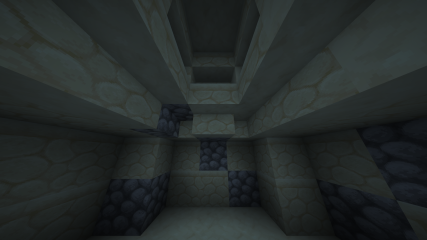 Inside a square-outside, round-inside girna, looking at the dome

Whole, ruined and enclosed
| Condition | What you see |
|---|---|
| Whole | the full build above |
| Ruined | only the bottom 2 or 3 courses stand, with the top course broken in places and no roof. About a third of the floor holds fallen stones. About 6 in 10 giren are ruined. |
| Enclosed | a low dry-stone wall, 1 or 2 blocks high, circles the girna with a gap at the front as a gate. The wall is 6.5 to 8.5 blocks in radius and centred 2 blocks in front of the hut. About 27 % of giren have one, whole or ruined. |
The six variants below each show a whole girna (left), a ruined one (middle) and one inside its enclosure (right). The first row is the round girna.
-
 Round, full size
-
 Small round
-
 Small oval
-
 Square
-
 Square outside, round inside
-
 Small, square outside, round inside


On the Bajda ridge
-
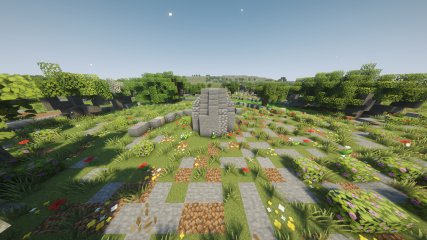 An oval girna
-
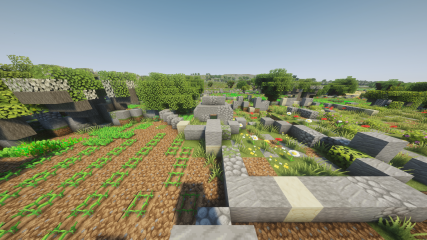 A small oval girna
-
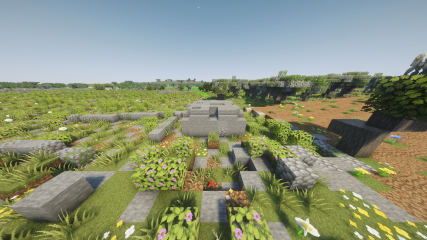 A ruined girna, square outside


- Bajda ridge, round girna in its enclosure:
/tp @s -2978 126 -1581 - Bajda ridge, oval girna:
/tp @s -3134 124 -1664
Sources
- The real huts: Vella (2012–2013), A stratigraphic study of the giren at Ix-Xagħra l-Ħamra, limits of Mellieħa, Malta, Malta Archaeological Review, issue 11. It surveys 37 giren on the Bajda ridge: 14 round, 13 oval, 8 rectangular and 3 niches in a wall, 10 of them in complexes with enclosures. The shares of the shapes, and the enclosures, follow it.
- Where they stand: the survey's map of 36 giren, fitted to the coast (accurate to about 150 m), and 8 giren that were checked by eye on the Planning Authority's 1968 survey sheets and the 2018 photo.
- Region densities: modelled from the survey and from reports of where giren occur. No complete list of giren exists.
- Stone: the island's own rock layers, see Rock layers.
- Size and look: modelled. The real huts vary widely. The world uses a few plain types.
Trivia
- An attempt to find giren automatically on the 1968 survey sheets by their round symbol failed: only about 1 in 7 of the best matches was a real girna. The rest were water tanks, sheds and round field corners.
See also
- Field room: the small stone stores at the field edges
- Upper Coralline Limestone: the rock the giren are built on and from
- Rock layers