Field room
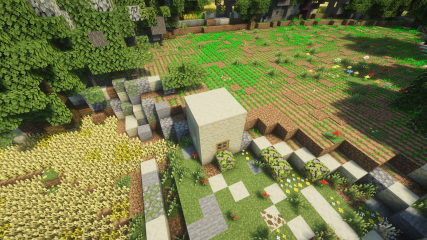
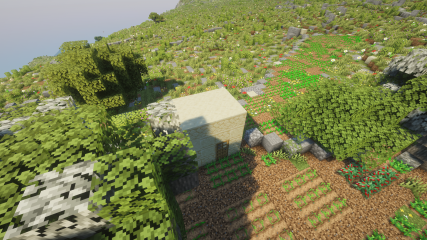
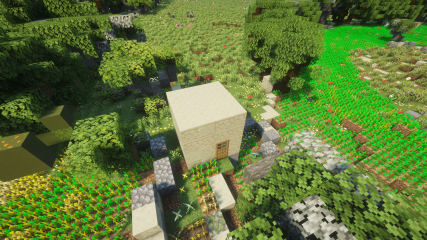
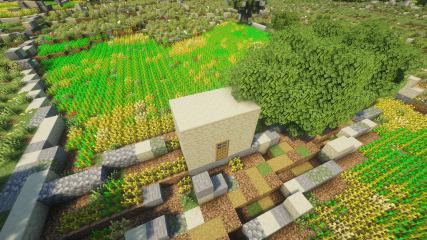
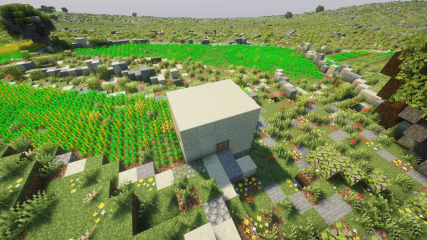
 A whole field room, 5 by 4 blocks, with its door facing the track | |
| Maltese | Kamra tal-għalqa |
|---|---|
| In the world | |
| Number | 8,167 (Malta 6,238, Gozo 1,929, Comino 0) |
| Found | At the edge of worked fields, next to a track |
| Sizes | 3 by 3 up to 5 by 5 blocks, 4 blocks high |
| Blocks | Sandstone, cut sandstone and smooth sandstone, an oak door, iron bars |
| Data | Planning Authority drawn map, 2018 surface model and aerial photo |
A field room (Maltese: Kamra tal-għalqa) is a small stone store that a farmer builds at the edge of a field to keep tools, seed and water, and to shelter from the sun. The islands have thousands of them. In Malta in Minecraft every one stands where a real one stands, at its real size.
How it differs from vanilla
- Real places, no random ones. Vanilla villages and outposts are placed by a random rule. Every field room in the world is a real building from the Planning Authority's drawn map of the islands, so a farm you know has its room in the right corner.
- They are part of the fields. The room stands in the middle of the farmland the world generates, and the rubble walls, steps and hedges leave its footprint free.
- Some have fallen down. About one room in seven is a ruin (see below).
- Nothing to loot yet. A whole room holds at most an empty barrel. No chest, no loot table.
Where they appear
A building becomes a field room only if it passes every test below. The tests were made strict on purpose, so that a house, a garage or a chapel is never built as a field room.
| Test | Rule |
|---|---|
| Size | 4 to 60 m² on the map, and no side longer than 5 blocks after the check against the surface model |
| Surroundings | it touches a field parcel (within 4 m), has no other building within 5 m, and has no building larger than 60 m² within 25 m (no annexes, garages or pool rooms beside houses) |
| Ground | on land outside towns, salt pans, pools and reservoirs, on ground that varies by no more than 3 blocks across the footprint |
| Height | its roof is 1–5 m above the ground on the 2018 surface model |
| Photo | it casts a shadow on the 2018 aerial photo, so it stands up from the ground |
| Labels | no church, chapel or convent label within 30 m, no cemetery or ancient-remains label within 12 m |
- Density. About 62 rooms per km² of farmland on Malta and about 55 on Gozo. The next room is a median 60–70 m away. From a random spot in a field the nearest room is about 80 m away, and about two thirds of all farmland is within 100 m of one.
- Accuracy. The tests keep about 93 % real field rooms. The rest are similar small roofed buildings, such as an annex or a small shed.
- Comino has none. The drawn map shows no field room there.
- Trees keep clear. No tree trunk grows within 3 blocks of the walls.
Variants
Whole rooms
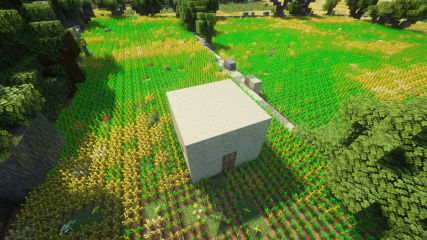
The footprint is the real building's footprint. The sizes that occur are 3 by 3, 4 by 3, 4 by 4, 5 by 3, 5 by 4 and 5 by 5 blocks. Every room has the same build.
- Walls and roof. Three courses of walls and a flat roof course on top, so 4 blocks high. The stone is a mix of sandstone (75 %), cut sandstone (17 %) and smooth sandstone (8 %), the pale limestone of the islands.
- Floor. Stone, with solid footing down to the ground.
- Door. An oak door in a long wall. It faces the nearest track if one is within 30 m, and a random direction if not.
- Window. One iron-barred window in a side wall.
- Barrel. A barrel stands in the back corner of every room whose inside is large enough for it. The 3 by 3 room has a 1 by 1 inside, so it has none.
-
 3 by 3
-
 4 by 3
-
 4 by 4
-
 5 by 3
-
 5 by 4
-
 5 by 5


Ruined rooms
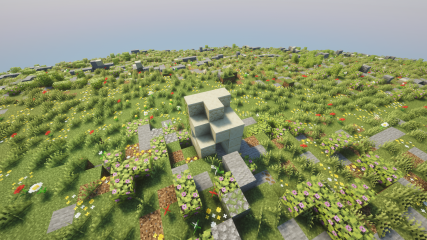
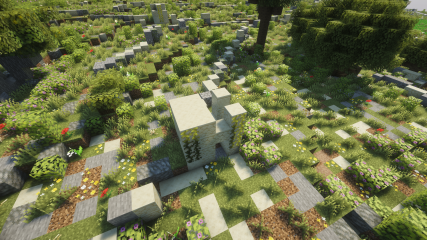
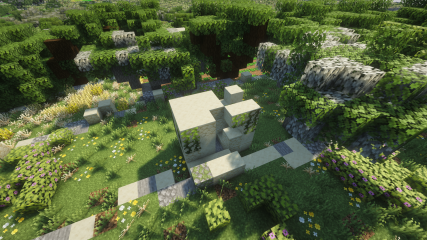
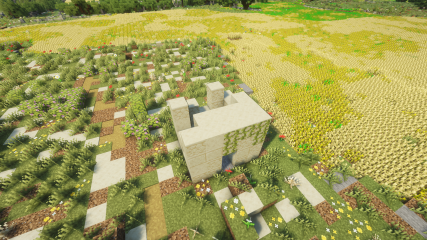
A ruined room has the same footprint as a whole one, in the sizes 3 by 3, 4 by 3, 5 by 3 and 5 by 5.
- Roof. It has fallen in from one end. The fallen part covers 35 to 75 % of the roof, with a ragged edge, and the top course of the wall is broken over the hole.
- Inside. Stones, slabs and cobblestone lie on the floor, with coarse dirt and grass coming through. The barrel is gone.
- Openings. The doorway has no door and the window has no bars.
- Vines. They hang down the outer walls and down the inner walls under the hole.
-
 3 by 3
-
 4 by 3
-
 5 by 3
-
 5 by 5


Which rooms are ruins
A room is more likely to be a ruin when abandoned fields lie round it, which is where real field rooms are left to fall down.
- A room with no abandoned field near it has a 2 % chance of being a ruin.
- Each abandoned field within 50 m makes it about 10 % less likely to stay whole. A field touching the room counts fully, and one 50 m away counts about a quarter as much.
- Six rooms that are known to be broken in real life are always ruins.
Across the islands this gives about 1,150 ruins among the 8,167 rooms, or about 14 %. A room with three or more abandoned fields near it is a ruin in about 3 cases out of 10.
- Whole 5 by 4 room:
/tp @s 5277 190 11223 - Ruined 3 by 3 room:
/tp @s 4281 175 11232 - Ruined 5 by 5 room:
/tp @s 4812 204 10544
Sources
- Positions and sizes: the Planning Authority's drawn map of the islands. Each room is a building on it.
- Checks: the 2018 surface model (roof height), the 2018 aerial photo (roof and shadow) and the label sheets of the drawn map. About 150 rooms were checked by eye.
- Look: modelled. Real field rooms vary in roof shape, render and door. The world gives them one plain build.